
Trading playbook Write your setups. Then see which ones pay.
The Playbook holds the trades you look for and the rules you follow on them. Review each trade against its setup, get a score for how well you kept to it, and build statistics on every strategy you trade.
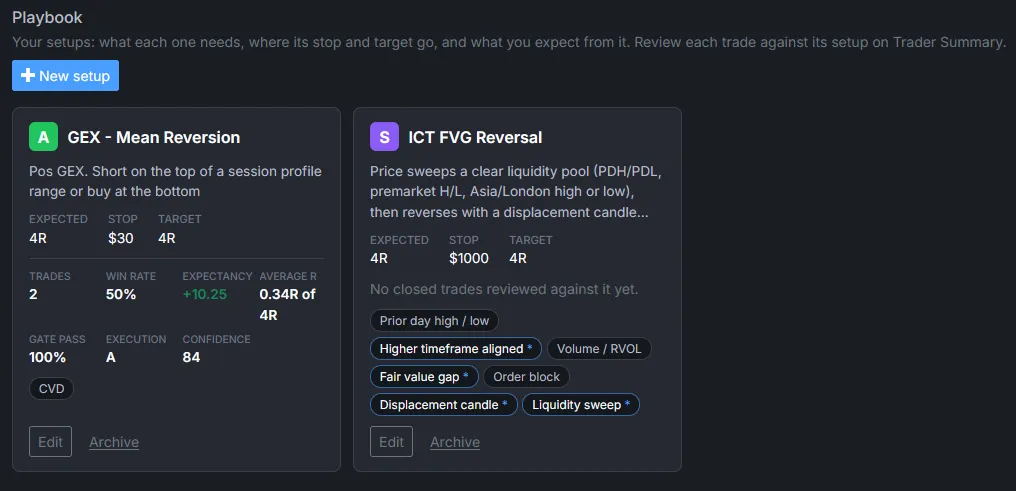
Write a setup
Your strategy, written down once
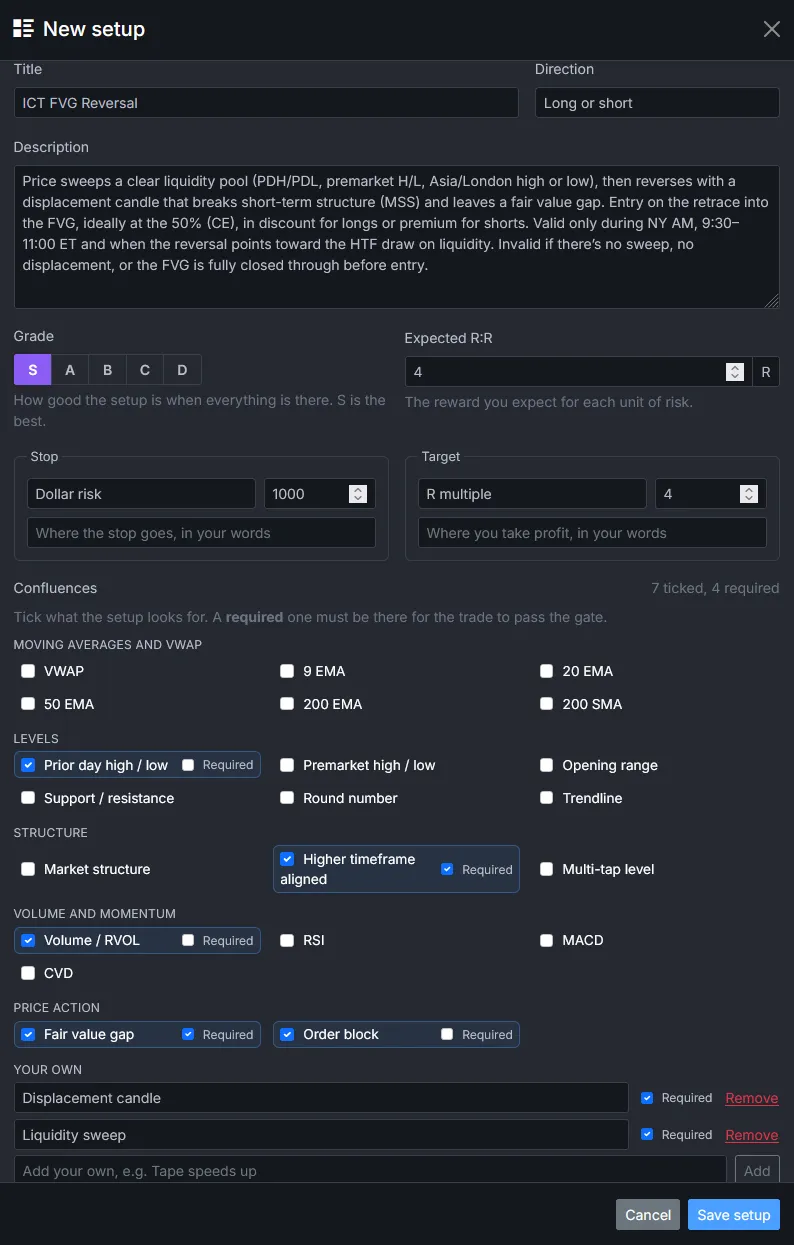
A setup is the trade you look for, in your own words: what it is, how good it is when everything lines up, where the stop and target go, and the reward you expect for each unit of risk.
- A title and a description of the trade
- A grade from S to D - S is the best
- Long, short or both
- A stop rule in points, in dollars or at a level
- A target rule, set the same way or as an R multiple
- The R:R you expect from it
Confluences
Say what the setup needs before you take it
Tick the confluences the setup looks for from 21 standard ones, and add your own. Mark the ones it can't do without as Required: those decide whether a trade passes the gate.
- 21 standard confluences in five groups
- Your own, in your own words
- Required or optional, per setup
- A count of what you ticked and what is required
-
Moving averages and VWAP
VWAP9 EMA20 EMA50 EMA200 EMA200 SMA
-
Levels
Prior day high / lowPremarket high / lowOpening rangeSupport / resistanceRound numberTrendline
-
Structure
Market structureHigher timeframe alignedMulti-tap level
-
Volume and momentum
Volume / RVOLRSIMACDCVD
-
Price action
Fair value gapOrder block
Trade review
Review every trade against its setup
Open a trade, choose the setup you took it on, and the review asks the questions a good coach would - in the same order, every time.
- 1
Pick the setup
An empty stop and target fill in from the setup's rules. A stop or target you already entered is never overwritten.
- 2
Tick what was there
The confluences that were really on the chart, and any warning signs. The form counts them: "3 of 4 validated, 2 of 2 required".
- 3
Read the result against the plan
The R the setup expects, the R you made, what 1R was in dollars, and the P&L.
- 4
Grade your execution
From S to D, next to the setup's own grade, with your notes on the trade.
- 5
Get Gate Pass and Confidence
Both sit at the top of the form and change as you tick, with a breakdown of every point.
Gate Pass
Pass when every required confluence of the setup was there. Fail when one was missing. It answers one question: was this really the setup, or did you talk yourself into it?
Warning signs
Every trade is checked against the same five. Each one that was there costs points.
- Missing key context
- Choppy candles
- Extended or late
- Invalidation unclear
- Conflicting signals
Confidence score
A score for the decision, not the result.
Confidence is a score out of 100 for how well a trade matched its setup and how well you kept to the setup's rules. It is worked out from your setup and your review, never typed in.
It rewards process. A loss taken at your stop on a well-followed setup scores as well as a win at the target. A win that broke every rule does not: with no stop, no confluences, a D for execution and four warning signs, the same setup scores 3.
- 70 points for the setup: its grade, its confluences and how you executed it
- 30 points for risk: the stop, the planned R:R and the outcome
- 5 off for each warning sign, up to 15
| Part | Max | Target hit+2R | Stopped out−1R | Stop ignored−2R |
|---|---|---|---|---|
| Setup grade | 15 | 13 | 13 | 13 |
| Required confluences | 25 | 25 | 25 | 25 |
| Optional confluences | 10 | 5 | 5 | 5 |
| Execution grade | 20 | 20 | 20 | 20 |
| Stop set | 5 | 5 | 5 | 5 |
| Stop respected | 10 | 10 | 10 | 0 |
| Planned R:R | 10 | 10 | 10 | 10 |
| Outcome | 5 | 5 | 5 | 0 |
| Warning signs | −15 | 0 | 0 | −10 |
| Confidence | 100 | 93 | 93 | 68 |
Stats by setup
Build statistics on every strategy you trade
Each review adds to its setup's record, so "I think this one works" becomes a number.
A card for every setup
The card shows the setup's rules and confluences, and how it has really done. If you expect 4R and average 0.34R, the card says so.
- Trades and win rate How often you take the setup, and how often it wins.
- Expectancy What the setup makes, on average, each time you trade it.
- Average R of expected R The R you really make against the R you wrote down.
- Gate Pass rate How often every required confluence was there.
- Execution grade Your average grade for how you traded it.
- Confidence Your average process score on the setup.
Trader Summary by setup
Pick a setup and the whole journal follows
A Setup selector sits beside the account on Trader Summary. Choose one setup and every trade figure on the page is that setup's alone, for the account and range you picked.
See the analytics it filters- All setups, one setup, or "No setup (to review)"
- Statistics, hourly table, drawdown, costs and equity curves
- The Edge, Excursion and Calendar tabs
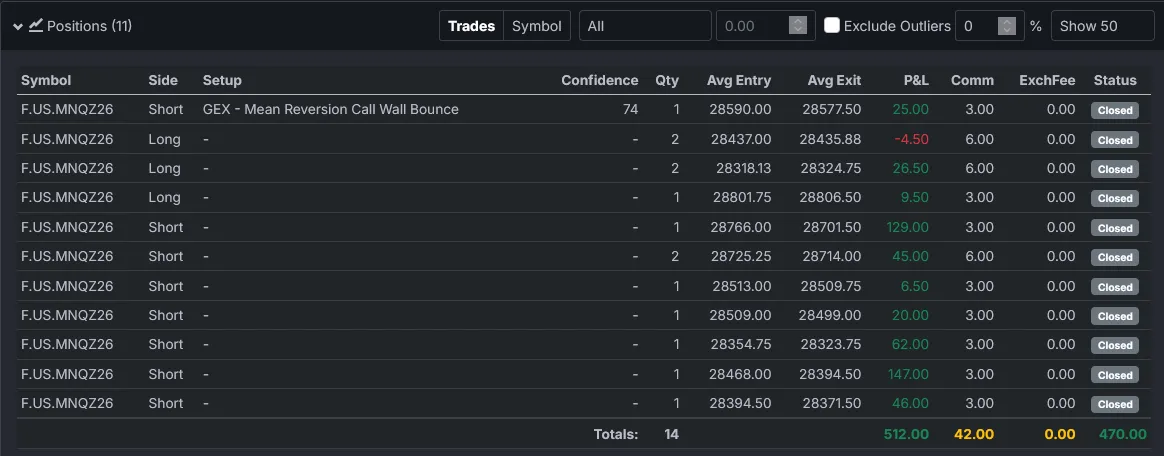
- A Setup column and a Confidence column on every position
- Sort by Confidence to find your best and worst process
AI insights
AI that reads your Playbook.
Once you review trades against a setup, Premo's trading insights look at whether keeping to it pays - and say so in plain words.
Explore AI insights- Gate passed vs failedDo the trades with every required confluence do better?
- Each confluence, there or notWhich ones carry the setup, and which don't matter.
- Execution and warning signsWhat a lower grade or a warning sign costs you.
- R made vs R expectedWhether the setup pays what you wrote down.
AI insights are opt-in. Your setup and confluence names are sent; their descriptions and your review notes never are.
Complete Trade Journal
The Playbook comes with the journal.
$15.99/month billed yearly (save 20%), or $19.99 month to month. Cancel anytime.
New to writing setups? Read what an A+ setup is and how to build a playbook, or see how Premo's Playbook compares.
FAQ
Playbook questions
What is a trading playbook?
A trading playbook is a written list of your setups: the trades you look for and the rules you follow on them. In Premo each setup has a title and description, a grade from S to D, the confluences it needs, a stop rule, a target rule and the R:R you expect, and its own statistics once you review trades against it.
What is a confluence, and what does Required mean?
A confluence is one reason for the trade, such as VWAP, the prior day high or a fair value gap. Premo offers 21 standard confluences in five groups and you can add your own. Mark the ones a setup can't do without as Required: a trade passes the gate only when every required confluence was there.
How is the Confidence score worked out?
It is a score out of 100, worked out from your setup and your review, never typed in. Up to 15 points for the setup's grade, 25 for required confluences, 10 for optional ones, 20 for your execution grade against the setup's, 5 for a stop that follows the setup's rule, 10 for respecting it, 10 for the planned R:R and 5 for the outcome. Each warning sign takes 5 off, up to 15.
Can a losing trade get a high Confidence score?
Yes. The score rewards process. A loss taken at the stop on a well-followed setup scores as well as a win at the target, and a win that broke every rule scores close to zero.
Can I see my statistics for one setup?
Yes. Every setup card shows its trades, win rate, expectancy, average R, Gate Pass rate, execution grade and Confidence. On Trader Summary, a Setup selector beside the account changes every trade figure on the page to that setup: the cards, hourly table, drawdown, equity curves, positions and the Edge, Excursion and Calendar tabs.
How do I find the trades I have not reviewed yet?
Choose "No setup (to review)" in the Setup selector on Trader Summary. The page then shows only the trades that have no setup, so you can work through them.
Does the Playbook work for every market you trade?
Yes. R is the risk you planned: the distance from your entry to your stop, times the size, times what a point is worth. For a stock a point is a dollar a share; for a future it comes from the contract, so 1R on MNQ, MES, NQ or ES is in real dollars.
Which plans include the Playbook?
Every plan. The Playbook comes with the Complete Trade Journal, the 14-day free trial included, and with the AI Stock Scanner plan.
What happens to a setup I stop trading?
Archive it. Setups are archived, never deleted, so the trades you reviewed against one keep their setup and their statistics. Archived setups sit behind a toggle and can be restored.