
Trading psychology: manage emotions with data
Trading psychology explained: the biases that cost traders money, how tilt shows up in your trades, and a routine that measures mindset against P&L.
Trading psychology is the way your emotions, biases and mental state change the decisions you make in the market. Two traders with the same strategy get different results because one of them sizes up after a win, moves a stop when scared and keeps trading after a loss to “make it back”. The strategy is the same. The trader isn’t.
Most advice about trading psychology is about willpower: be disciplined, stay calm, follow your plan. That advice is true and nearly useless, because the moments that need discipline are exactly the moments when you have the least of it.
A better approach is to treat your mindset as data. Measure it before the session, compare it with your results afterwards, and set rules for the states that cost you money. This guide covers the biases that matter most, how they show up in a trade log, and a daily routine that turns psychology into something you can track.
Key takeaways
- Your state changes every day; your strategy doesn’t. Bad days are often bad-state days.
- Four biases do most of the damage: loss aversion, the disposition effect, overconfidence and recency.
- Tilt and revenge trading leave fingerprints - bigger size, more trades, losses bigger than your stop.
- Decide before the open. Rules made in calm hold better than rules made mid-drawdown.
- Measure your mindset against your P&L to find the conditions that come before your worst days.
The four biases that cost traders the most
Loss aversion
Losses hurt more than gains of the same size feel good - research by Daniel Kahneman and Amos Tversky put the difference at roughly two to one. In trading, it shows up as an unwillingness to take a small loss, which turns small losses into big ones.
The disposition effect
Closely related: the tendency to sell winners too early and hold losers too long. You lock in a gain the moment it appears, but give a losing trade “room to come back”. Over many trades the result is a realized R:R well below what your setups offer.
Overconfidence
After a winning streak, traders tend to believe their edge is larger than it is. Size goes up, criteria loosen, and the next ordinary losing streak costs far more than it should.
Recency bias
The last few trades feel more important than the last few hundred. Three losses in a row and a good strategy feels broken; three wins and a bad habit feels like skill.
Tilt and revenge trading: what they look like in your trades
You rarely notice tilt while it’s happening. Your trade log does. Look for:
| Sign in your trades | What it usually means |
|---|---|
| Larger size right after a loss | Trying to win back the loss in one trade |
| Many trades in a short window | Chasing - entering on impulse, not on setup |
| A loss bigger than your planned stop | A stop that was moved or ignored |
| Losers held much longer than winners | Hoping instead of exiting |
| A big loss late in a green day | Giving back gains after the plan said stop |
The fourth row is easy to check: compare the median time you hold losing trades with the median time you hold winning ones. If losers last much longer, the disposition effect is in your numbers. For losses bigger than planned, look at MAE - how far trades went against you - which we cover in What are MFE and MAE?.
Why willpower isn’t the answer
Every rule in a trading plan is easy to follow when you are calm. The trouble is that the rules matter most when you are not: after a fast loss, during a drawdown, at the end of a long day. Stress narrows attention and pushes you toward whatever ends the discomfort fastest - usually another trade.
That is why the most reliable psychology tools are made in advance:
- A maximum daily loss that ends the session automatically.
- A fixed position size that does not change with your mood.
- A list of red flags that mean stop, written while you’re calm.
- A check of your state before the open, so a bad day can be a small day.
A daily psychology routine in three steps
1. Check in before the open
Rate how you are, honestly, before you look at a chart. Score a handful of things on the same scale every day - for example energy, focus, stress, confidence, impulse risk and sleep, each from 0 to 10. It takes a minute. Over weeks it becomes the most revealing data in your journal.
2. Write your intent and your red flags
Write one line about how you intend to trade today, the rules you will follow, and the red flags that mean you stop. For example:
- Intent: “Two A+ setups at my levels, then done.”
- Rules: “Stop goes in with the order. No adding to losers.”
- Red flags: “Two losses in a row. Any urge to size up. Trading before 9:30.”
3. Prepare your levels
Mark the levels you will trade before the session opens, and decide where you would act and where you wouldn’t. A plan that exists before the open is far harder to abandon than one you make up as you go.
After the close: match your mindset to your results
This is where psychology becomes data. Once you have check-ins and closed trades on the same days, you can ask questions with real answers:
- Correlation: do higher sleep scores line up with higher daily P&L? Does high impulse risk line up with lower win rate?
- High days vs low days: what is your average P&L on days when a score was above your usual level, against days when it was below?
- Sample size: how many days is each finding based on? Ten days is a hint. Sixty is a pattern.
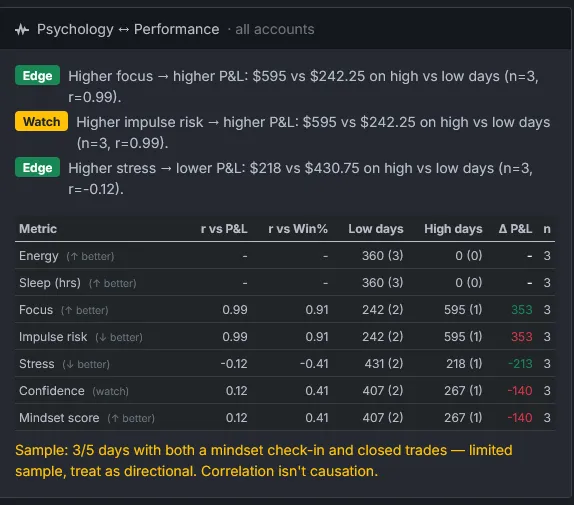
Psychology ↔ Performance after three days. Focus and stress point the way you’d expect. Impulse risk “predicts” higher P&L, so it’s flagged Watch. Three days can’t separate the two. Here the high-focus day was also the high-impulse day. The panel says so: limited sample, treat as directional. This is why the day count sits next to every finding.
The answers are personal. One trader finds that sleep is their biggest edge. Another finds that their most confident days are their worst ones. You can’t know which you are until you measure it - and once you know, you have a rule you will actually follow: on a low-sleep or high-impulse morning, trade smaller or not at all.
How Premo helps
Premo Trading’s Trader Psychology routine starts every day with a check-in of six scores - energy, focus, stress, confidence, impulse risk and sleep - plus your intent, rules, red flags and notes. After the close, Psychology ↔ Performance lines each check-in up with that day’s closed trades and shows the correlation with your P&L and win rate, your results on high days against low days, and how many days each finding rests on.
This article is educational and is not investment advice. Trading involves substantial risk of loss.
Frequently asked questions
What is trading psychology?
Trading psychology is the effect of a trader's emotions, biases and mental state on their decisions. Fear, greed, overconfidence and the urge to win back losses all change how you size, enter and exit trades - often without you noticing in the moment.
Why do I lose money after a big win?
After a big win, many traders feel more confident than their edge justifies. They size up, loosen their criteria or keep trading past their plan. Overconfidence after wins is a well-documented bias. A fixed position size and a daily profit stop are simple defences.
How do I stop revenge trading?
Decide in advance what ends your day: a maximum daily loss, a maximum number of losing trades in a row, or a red flag such as moving a stop. Write it down before the open and stop the moment it is hit. Revenge trading is a decision made under stress, so the decision has to be made before the stress.
Does journaling help trading psychology?
Yes, if it records your state as well as your trades. A journal that captures sleep, stress and focus next to each day's P&L lets you see which conditions come before your worst days, so you can trade smaller or not at all when they appear.
What is tilt in trading?
Tilt is a state where emotion has taken over your decisions, usually after a loss or a run of losses. Signs include bigger size, faster entries, trading setups you would normally skip and ignoring stops. It is borrowed from poker, where it means the same thing.