
Prop firm trading journal: track the rules that end accounts
How to journal prop firm evaluation and funded accounts: daily loss limit, trailing drawdown, consistency rules, position sizing and the stats that decide whether you pass.
A prop firm trading journal records every trade in an evaluation or funded account next to that account’s rules - the daily loss limit, the maximum or trailing drawdown, the profit target and any consistency rule - so you can see how close each trade brought you to losing the account, and which habits keep putting you there.
Prop firm accounts reward traders who survive. The profit target is the part everyone talks about, but the account ends on a drawdown or a daily loss, not on a missed target. A strategy with a real edge still fails an evaluation when it’s sized for the target instead of the limits.
This guide covers the rules worth tracking, how to size trades around them, what to record for each account, and the statistics that tell you whether you’re likely to pass.
Key takeaways
- The limits end the account, not the target. Track room to the daily loss limit and the drawdown on every trade.
- Size from the smallest limit. Risk a fraction of the daily loss limit per trade, not a fraction of the account balance.
- One account, one set of statistics. Copy trading to five accounts doesn’t give you five times the sample.
- Recovery matters as much as drawdown. How many trades it takes you to get back to a high decides how a trailing drawdown treats you.
- Rules change. Firms revise them often. Check your firm’s current rulebook, not a summary.
Which prop firm rules should you track?
Every firm words its rules differently and changes them from time to time, so treat this as a checklist to fill in from your own firm’s rulebook:
| Rule | What it means | What to track |
|---|---|---|
| Profit target | Profit needed to pass the evaluation | Distance to target, in dollars and in average winning days |
| Daily loss limit | Most you can lose in one session | Room left today, after every trade |
| Maximum drawdown | Most the balance can fall below a reference | Room left, and whether the reference moves |
| Drawdown type | Static, trailing intraday, or trailing end-of-day | When the floor moves (see below) |
| Consistency rule | Your best day can be at most a set share of total profit | Best day ÷ total profit |
| Minimum days | Trading days required before you pass | Days traded |
| Contract limit | Most contracts you can hold | Largest position per trade |
| News and session rules | Restrictions around releases or overnight holds | Trades placed in restricted windows |
The drawdown type changes everything. With a static drawdown, the floor never moves. With a trailing drawdown, it rises as your balance makes new highs - intraday, from the highest open-trade equity, or at the end of each day, from the highest closing balance. A trade that runs $1,000 in your favor and comes back to breakeven costs you nothing on a static drawdown and can cost you $1,000 of room on an intraday trailing one.
How to size trades in a prop firm account
Size from the limit you can break fastest. On most accounts, that’s the daily loss limit.
Take an example $50,000 evaluation with a $1,000 daily loss limit and a $2,500 trailing drawdown. These numbers are for illustration only.
| Step | Calculation | Result |
|---|---|---|
| Risk per trade | ¼ of the $1,000 daily limit | $250 |
| MNQ stop | 25 points × $2 | $50 per contract |
| Position size | $250 ÷ $50 | 5 MNQ |
| Losers in a row before the daily limit | $1,000 ÷ $250 | 4 |
| Losers in a row before the drawdown | $2,500 ÷ $250 | 10 |
Five micros, not one NQ. One NQ with the same 25-point stop risks $500 - half the day’s limit on one trade. The futures position size calculator does this arithmetic for any contract and stop, and the trailing drawdown calculator shows where your floor sits and how much room is left. For where to put the stop and target in the first place, see risk-reward ratio.
The consistency rule matters at the other end. If your firm’s rule says your best day can be at most 30% of total profit, a $3,000 target means no single day should make more than $900 of it. A $1,500 day doesn’t fail you, but it moves the finish line. Check how your firm words its rule before you rely on this arithmetic.
What to record for every prop account
Your journal should hold:
- An account label on every trade. “Eval-50K-1”, “Funded-2” - whatever you use, consistently. Analytics then work per account or across all of them.
- The rules for that account, written down once: target, daily limit, drawdown type and size, consistency rule, contract limit.
- Room to each limit after every trade. Not just at the end of the day. The trade that took you within $100 of the daily limit is the one to review.
- Your mindset before the session. Tired or tilted traders break daily limits. A short pre-market check-in, matched to P&L over a few weeks, shows which of your states are expensive. More in trading psychology.
- Resets and payouts. What each evaluation cost you, and what each funded account paid. It’s the honest P&L of prop trading.
If you copy the same trades to several accounts, pick one account for your statistics. Five copies of a trade aren’t five data points, and they make a small sample look large.
The statistics that decide whether you pass
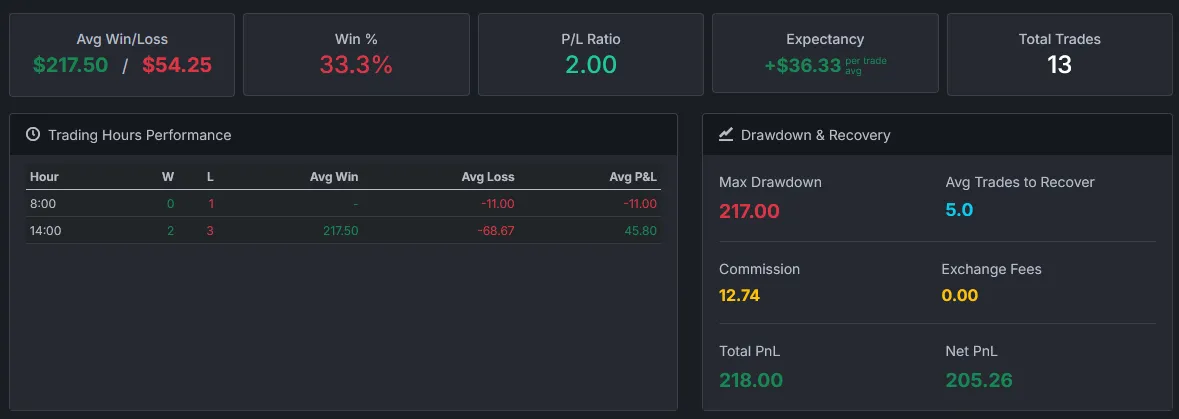
One win in three, and still a positive expectancy, because the average win is four times the average loss. Max drawdown and trades to recover are the two numbers a trailing drawdown cares about most.
- Expectancy per trade. If it’s negative after fees, no rule set will save the account. If it’s positive, the question is only whether you survive the variance. See expectancy.
- Max drawdown. Your own worst peak-to-trough fall, compared with the firm’s limit. If your normal drawdown is $2,000 and the limit is $2,500, a slightly bad week ends the account.
- Average trades to recover. How many trades it takes to get back to a high after a drawdown. Slow recovery under a trailing drawdown means the floor sits close for a long time.
- Losing streaks. Your longest run of losers times your risk per trade should fit inside the daily limit and the drawdown with room left over.
- P&L by hour. Many traders make the evaluation in the first hour and give it back at lunch. Stop trading the hours that cost you.
- Commissions. On micros, fees can turn a marginal edge negative. Track net P&L, not gross.
Mistakes that fail prop accounts
- Sizing for the target. Trading NQ to hit $3,000 in a week, on a $2,500 drawdown.
- Revenge trading after a loss. The daily limit exists for this. Stop at half of it.
- Ignoring how the drawdown trails. Letting a big open profit come back on an intraday trailing account.
- Trading through news. Breaking a news rule, or taking a 30-point slip at 8:30 a.m. ET.
- Treating every evaluation as the same. Rules differ between firms and between account sizes at the same firm.
For the full list and the journal metric that exposes each one, see 10 common trading mistakes. For writing your own rules down before the session, see how to create a trading plan.
How Premo helps
Premo Trading’s journal plan includes unlimited accounts, so every evaluation and funded account gets its own label and its own statistics, or you can view all of them together. Import the fills from your platform’s export and Premo rebuilds every position and shows expectancy, max drawdown, trades to recover, commissions and P&L by hour of day. A pre-market check-in tracks your state before each session. See how Premo works as a prop firm challenge journal, or start with Performance Analytics.
This article is educational and is not investment advice. Prop firm rules vary by firm and change over time; always read your firm’s current rules. Futures trading involves substantial risk of loss.
Frequently asked questions
What is a prop firm trading journal?
A record of every trade in a prop firm evaluation or funded account, kept next to the account's rules: daily loss limit, maximum or trailing drawdown, profit target and any consistency rule. It answers two questions a normal journal doesn't: how close am I to breaking a rule, and which of my habits keep bringing me there.
Why do most prop firm evaluations fail?
A strategy with no edge fails any evaluation, but a strategy with an edge also fails when it is sized for the profit target instead of the drawdown. One oversized loss or one bad day uses up a limit that took weeks to build room under.
How much should I risk per trade in a prop firm evaluation?
Size from the smallest limit you can break, usually the daily loss limit. Many traders risk a quarter or less of the daily limit per trade, so three or four losses in a row still leave them inside the rules for the day.
Should I journal each prop account separately?
Yes. Each account has its own drawdown and its own rules. If you copy the same trades to several accounts, analyze one of them for your statistics - otherwise five copies of a trade count as five trades and inflate your sample.
Does a trading journal connect to Apex or Topstep?
Prop accounts trade through a platform such as Tradovate, Rithmic or NinjaTrader. A journal imports the fills from that platform's export. Premo reads TradingView's Tradovate and AMP exports today and adds other platforms within 24 hours of receiving an export.