
How to create a trading plan (with a free template)
How to create a trading plan: markets, sessions, setups, risk per trade, a daily loss limit and a review routine, with a copy-paste template.
A trading plan is a written set of rules that decides what you trade, when you trade, how much you risk and when you stop - before the market opens. It turns the hundreds of decisions you would otherwise make under pressure into a handful you make once, while you’re calm.
Most traders know they should have one. Fewer have one written down, and fewer still follow it. The usual reason is that plans are too long, too vague or too ambitious. A good plan is short, specific and boring.
This guide walks through each section of a trading plan, gives an example for each, and ends with a copy-paste template.
Key takeaways
- A plan is not a strategy. A strategy is a setup; a plan is the business around it.
- Six sections cover it: markets, sessions, setups, risk per trade, daily limits and review.
- Every rule should be checkable - “1% per trade”, not “manage risk”.
- Keep it to one page. If you can’t read it before the open, you won’t follow it.
- Measure whether you follow it. Adherence is a number, just like P&L.
Trading plan vs trading strategy
A strategy is your rules for one way of trading: the setups that qualify, where the entry goes, where the stop and target go - see what is a trading strategy. A trading plan wraps one or more strategies in rules about the rest of the business: which markets, which hours, how much risk, when to stop and how you review. You can have a good strategy and still lose money without a plan, because the plan is what stops a good strategy from being traded badly.
The six sections of a trading plan
1. Markets
What you trade - and, just as important, what you don’t. Fewer is better. One or two markets you know deeply give you more consistent trades than ten you know a little.
Example: “MNQ only. No other contracts, no stocks, no options.”
2. Sessions
The hours you trade and the events you avoid. Most day traders have hours that pay and hours that don’t; your plan should name them.
Example: “9:30 to 11:30 a.m. ET. No trades in the two minutes after an 8:30 release. Flat before FOMC announcements.”
3. Setups
Each setup you trade, written precisely enough that someone else could find it on a chart: what qualifies, what disqualifies, the entry, the stop and the target. One or two setups are enough.
Example: “Setup A: retrace into a 5-minute fair value gap after a break of the prior swing high. Entry at the gap midpoint, stop below the gap, target the next swing high, minimum 2:1.”
If you need a starting point, our guides to the ICT FVG reversal and fair value gaps are written as rules. To grade your setups and write them into a playbook, see trading setups.
4. Risk per trade
How much you risk on each trade, as a fixed share of the account, and how you turn it into a position size. This is the rule that keeps you in business.
Example: “1% of the account per trade. Contracts = risk budget ÷ (stop in points × $2). Never more than 2 MNQ contracts.”
For how far your target needs to be from your stop, see our risk-reward ratio guide.
5. Daily limits
When the day ends, whatever happens. A maximum loss for the day, and optionally a maximum number of trades and a rule for stopping after a run of losses.
Example: “Stop for the day at −3R or after 4 trades. After two losses in a row, a 30-minute break.”
6. Review
When and how you review your trades. Without this section, the plan never improves.
Example: “Import fills after every session. Weekly: win rate, expectancy and P&L by hour. Monthly: decide whether any rule changes, based on at least 50 trades.”
Add a pre-market routine
A plan works best when you read it at the start of every session. A short routine before the open does that:
- Check in with yourself. Sleep, stress, focus. On a bad morning, trade smaller or not at all - see our guide to trading psychology.
- Check the calendar for economic releases and events.
- Mark your levels for the session.
- Read your plan, and write one line of intent for the day.
A free trading plan template
Copy this into a document and fill in each line. Keep it to one page.
| Section | Your rule |
|---|---|
| Markets | I trade: ___ . I do not trade: ___ . |
| Sessions | I trade from ___ to ___ (time zone). I avoid: ___ (events, hours). |
| Setup A | Qualifies when: ___ . Entry: ___ . Stop: ___ . Target: ___ . Minimum reward-to-risk: ___ . |
| Setup B | Qualifies when: ___ . Entry: ___ . Stop: ___ . Target: ___ . Minimum reward-to-risk: ___ . |
| Risk per trade | ___ % of the account. Size = risk ÷ (stop distance × point value). Maximum size: ___ . |
| Daily loss limit | I stop for the day at −___ R or −$___ . |
| Other limits | Maximum ___ trades a day. After ___ losses in a row I take a ___ -minute break. |
| Red flags | I stop immediately if: ___ (for example, moving a stop or adding to a loser). |
| Pre-market routine | Check-in, calendar, levels, read this plan, write today’s intent. |
| Daily review | After the close I: ___ . |
| Monthly review | On ___ I review: expectancy, win rate, P&L by hour and setup. Rules change only after ___ trades. |
| Monthly goal | Profit goal: $___ , based on my expectancy of $___ per trade × ___ trades. |
The last row is worth a moment. A goal based on your expectancy and how many trades you take is a forecast. A goal picked because it’s a round number is a reason to overtrade. Our guide to expectancy shows how to set one.
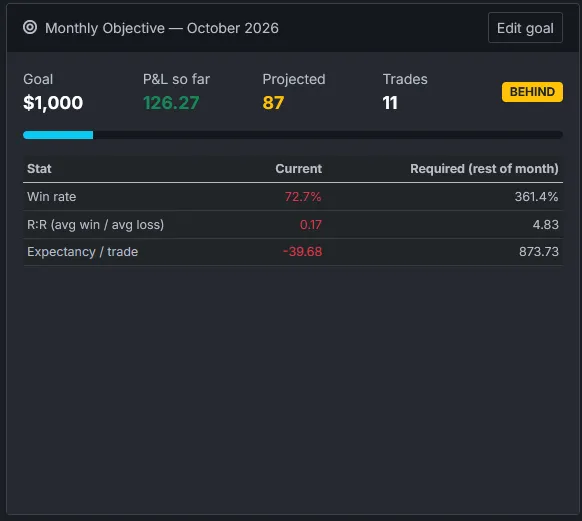
A round-number goal meeting reality. At the current pace the month projects to $87, and reaching $1,000 would need a 361% win rate - impossible. The right response is to reset the goal from your expectancy, not to trade more or bigger to catch up.
How to stick to your plan
- Decide before the open. Every rule above is made while calm.
- Make limits automatic where your platform allows it - a daily loss limit set at the broker is stronger than one in your head.
- Track adherence. For every trade, record whether it followed the plan. After a month, compare the results of planned and unplanned trades. The difference is usually persuasive.
- Change the plan on a schedule, not after a bad day.
The most common ways traders break their plans - oversizing, moving stops, trading outside their hours - are covered in 10 common trading mistakes.
How Premo helps
Premo Trading turns the review section of your plan into numbers. Monthly objectives track your realized P&L against your goal, project where the month will finish and show the win rate, reward-to-risk and expectancy you need for the rest of the month. The pre-market check-in records your intent, rules and red flags every day, and the Playbook scores each reviewed trade for how well it kept to its setup - so you can measure your discipline, not just your P&L. See the Trade Journal. For the numbers in the plan itself, try the free position size and expectancy calculators.
This article is educational and is not investment advice. Trading involves substantial risk of loss.
Frequently asked questions
What should a trading plan include?
At minimum: the markets you trade, the hours you trade, your setups with entry, stop and target rules, your risk per trade, a daily loss limit, and a routine for reviewing your trades. A plan that covers those six things answers every question you would otherwise answer in the moment.
What is the difference between a trading plan and a trading strategy?
A strategy is your rules for one way of trading: the setups that qualify and where the entry, stop and target go. A trading plan is the business around your strategies - what you trade, when, how much you risk, when you stop for the day and how you review. A plan can contain several strategies.
How long should a trading plan be?
One page is enough for most traders. A plan you cannot read in two minutes before the open is a plan you will not follow. Keep the detail for each setup on a separate page, and the plan itself short.
How often should you update your trading plan?
Review it on a fixed schedule - for example monthly - and change it only based on enough trades, such as 50 or more for a setup. Changing the plan after every losing day is a way of not having one.
How do you stick to a trading plan?
Make the decisions before the session, keep the plan short, set a hard daily loss limit, and measure how often you followed it. Most traders follow their plan better once they can see, in their own results, what breaking it costs.