
ICT FVG reversal: change of character, then the gap entry
The ICT CHoCH and fair value gap reversal as rules: the downtrend, the change of character, the gap midpoint entry, stop, target and what kills it.
The ICT reversal looks for a market in a downtrend that breaks its pattern for the first time, then enters on the pullback into the fair value gap that break left behind. The break is called a change of character (CHoCH): price takes out the most recent lower high. The entry is the midpoint of the gap, the stop goes just below the final low, and a daily close below that low kills the setup.
It is one of the most popular setups to come out of ICT (Inner Circle Trader) concepts, and one of the most loosely described. Ask five traders where the change of character is on the same chart and you will get five answers.
This guide writes the setup down as objective rules, all computed from price bars - no indicators, no judgment calls. It’s the same rule set we run as a scanner strategy, which is the only way a setup like this can be tested honestly.
Key takeaways
- Four conditions, in order: an established downtrend, a change of character, no break back below the final low, and a retrace into a fair value gap.
- The entry is fixed: the midpoint of the gap, not the current price.
- The stop is structural: just below the final lower low. Below it, the downtrend has resumed.
- The target is the prior lower high, and the trade needs at least 2:1 reward-to-risk.
- One rule is absolute: a daily close below the final low after the CHoCH ends the setup.
The building blocks
Every label below comes straight from daily price bars.
- Swing high: a bar whose high is above the highs of the two bars on each side of it. A swing low is the mirror image.
- Lower high (LH): a swing high below the previous swing high. Lower low (LL): a swing low below the previous swing low.
- Break of structure (BOS), bearish: a daily close below the most recent lower low. The downtrend continues.
- Change of character (CHoCH), bullish: price trades above the most recent lower high. The sequence of lower highs is broken for the first time.
- Fair value gap (FVG), bullish: three bars in a row where the third bar’s low is above the first bar’s high. The space between them is the gap, and its midpoint is (first bar’s high + third bar’s low) ÷ 2.
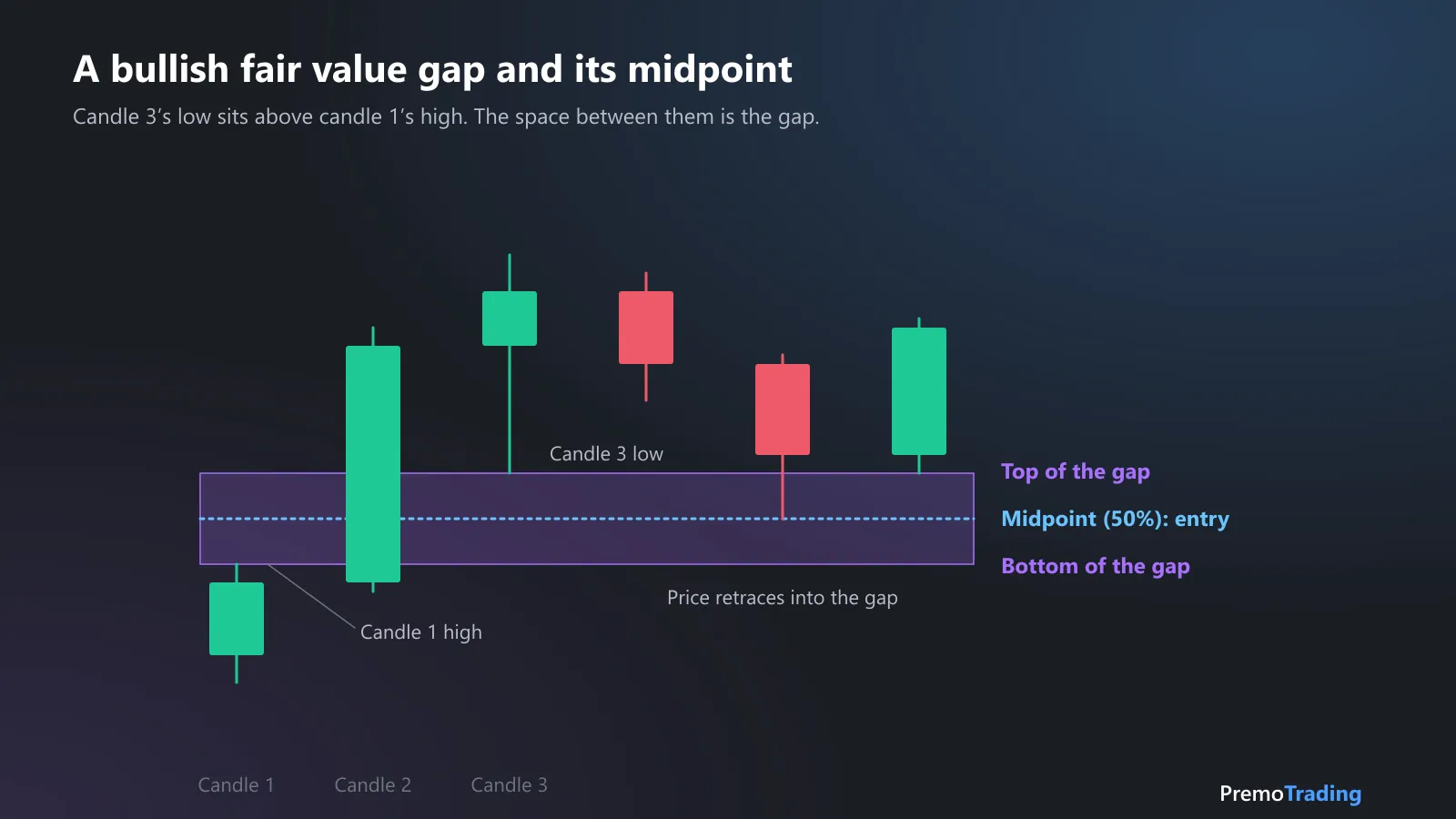
A bullish fair value gap. The impulse candle moves so fast that candles 1 and 3 never overlap - and price often comes back to fill part of that space.
We cover fair value gaps in depth - types, inversion, and how often they fill - in our fair value gap guide. Here we only need the basic definition.
The setup, condition by condition
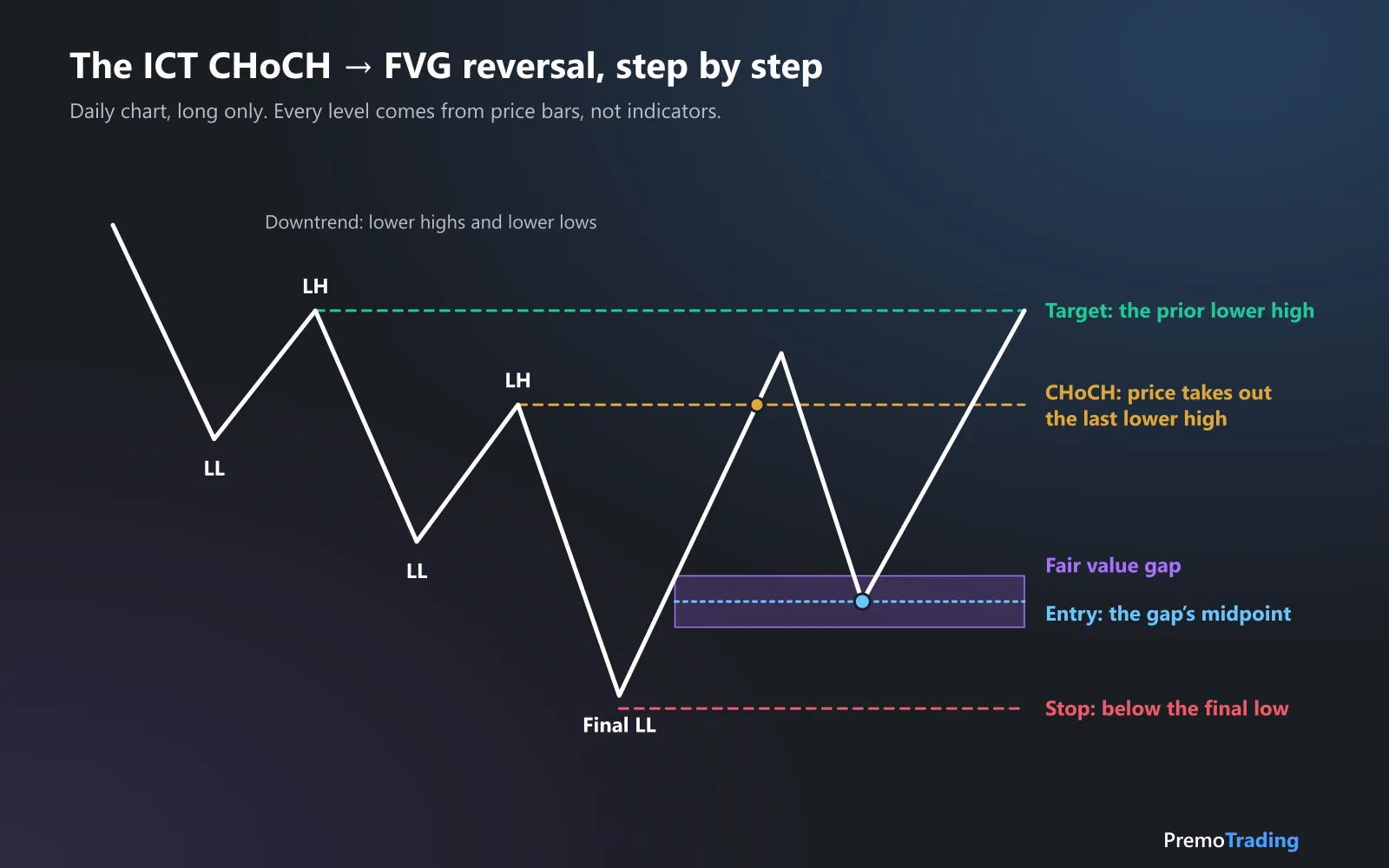
The whole setup in one picture. Every level is a property of the chart’s structure, so it doesn’t drift as new bars arrive.
1. An established downtrend
The market must objectively be falling: at least two lower lows and two lower highs in the last 200 daily bars, and a decline of at least 20% from the first lower high to the final lower low. Mark two anchors: the final lower low and the last lower high before the break. Everything else hangs off these two levels.
2. The change of character
After the final lower low, price trades above the last lower high. That is the CHoCH. A wick through the level counts; a daily close through it is stronger. A CHoCH more than about 40 bars old is stale.
On its own, the CHoCH is enough to put a symbol on a watch list. It isn’t yet a trade.
3. No close below the final low
This rule overrides everything else. If, at any point after the CHoCH, a daily bar closes below the final lower low, the setup is dead. The downtrend has resumed, and the change of character was a trap. Drop the symbol entirely - it isn’t late, and it isn’t on watch.
4. The retrace into a fair value gap
The impulse that broke the lower high usually leaves a bullish fair value gap behind. Look for one formed on or after that leg, then filter it:
- Width: narrower than 0.5% of price is noise, not a gap.
- Age: older than about 30 bars is stale.
- Position: prefer the gap price is retracing into now, and one that is still at least partly unfilled.
If no gap qualifies, a double bottom at the final low is an acceptable substitute trigger: two lows within 2.5% of each other, at least three bars apart, with a bounce of at least 3% between them. The entry is then the high of the bar that rejected the second low. When both are present, the gap takes precedence.
Entry, stop and target
- Entry: the fair value gap’s midpoint. Not the current price and not the edge of the gap. The level comes from the gap, and it doesn’t move. If the midpoint is $51.00 and the stock trades at $56.00 today, the entry is still $51.00 - and the $56.00 tells you the entry may have passed.
- Stop: 1.5% below the final lower low. That low is the structural invalidation. Below it, the downtrend has resumed.
- Target: the nearest prior structural high above the entry - usually the lower high before the one that was broken. If there isn’t one, project the distance from the final low to the CHoCH high upward from the entry.
- Minimum reward-to-risk: 2:1. Below that, the trade has already given up its edge.
A worked example
| Level | How it’s set | Price |
|---|---|---|
| First lower high | Start of the downtrend | $85.00 |
| Final lower low | Downtrend low (−52.9%) | $40.00 |
| Last lower high | The level the CHoCH breaks | $74.00 |
| CHoCH high | Top of the impulse leg | $80.00 |
| Fair value gap | On the impulse leg | $48.00 - $54.00 |
| Entry | Gap midpoint | $51.00 |
| Stop | $40.00 × (1 − 1.5%) | $39.40 |
| Target | Prior lower high | $85.00 |
| Risk / reward | $11.60 / $34.00 | 2.9 : 1 |
Because the stop sits at the structural low and the entry sits at a retracement, reward-to-risk is usually favorable. If it isn’t, that tells you price has already moved away from the entry. For how 2.9:1 translates into the win rate you need, see our risk-reward ratio guide.
Valid, late or watch: reading the state of a setup
Most charts that pass the first three conditions are not tradable today. Sorting them into three states keeps you honest:
| State | What it means |
|---|---|
| Valid | Downtrend, CHoCH, no close below the final low, a qualifying gap, and price is in or near it (no more than about 8% above it), with at least 2:1 reward-to-risk. |
| Late entry | The structure is intact, but the retracement entry has passed: price is back above the CHoCH high, or well above the gap, or reward-to-risk is below 2:1. What’s left is the confirmation break - a valid but later entry. |
| Watch | A downtrend and a CHoCH, no close below the final low, but no qualifying gap yet, or price hasn’t come back toward one. This is the most common state. |
And a lot of charts simply drop out: no CHoCH, a CHoCH that’s too old, a downtrend that’s too shallow, or a close below the final low.
What makes the setup stronger or weaker
| Stronger | Weaker |
|---|---|
| The CHoCH was a close above the lower high, not just a wick | The break was a wick that closed back below |
| The gap is still largely unfilled | The gap is more than three-quarters filled |
| Volume expanded on the CHoCH leg | The downtrend had only the minimum two swings |
| Three or more lower lows and lower highs before the break | Price already closed back below the gap without reaching the stop |
| The final low also formed a double bottom | Earnings within the next five trading days |
| Reward-to-risk of 3:1 or better |
Keep the levels stable
A setup’s entry, stop and target belong to the gap and the final low, not to the day you look at the chart. Re-checking the chart tomorrow should give the same three levels. What legitimately changes is the state (valid, late, watch) and the reward-to-risk as price moves.
Only four things reset a setup: a close below the final low, a new downtrend leg with fresh lower lows and highs, a newer unfilled gap closer to price, or the CHoCH or gap aging past its limit. Moving the entry to keep it near the current price is how a disciplined setup quietly turns into chasing.
Does the ICT reversal work?
ICT concepts were popularized by Michael J. Huddleston under the Inner Circle Trader name, and they are widely taught and widely argued about. The honest answer to “does it work?” isn’t a claim either way - it’s a test.
Written as rules like the ones above, the setup becomes testable: the same chart always gives the same answer. Run it across a watchlist, record every signal, and compare what the setup flagged with what you actually traded and how those trades did. After enough signals, your own expectancy tells you whether it works for you, in your markets, with your execution. Our guide to expectancy explains how to read that number.
How Premo helps
Premo Trading’s AI Stock Scanner runs strategies written in plain English - like the rules in this article - across your watchlist. A fast local pre-screen narrows the list on the numbers, then the AI reviews the candidates and returns each setup classified, with entry, stop, target, reward-to-risk and its reasoning. Every scan is saved with the strategy version it ran, so you can compare what the scanner found with what you traded.
This article is educational and is not investment advice. Trading involves substantial risk of loss.
Frequently asked questions
What is a change of character (CHoCH) in trading?
A change of character is the first break in a trend's structure. In a downtrend of lower highs and lower lows, it is the moment price trades above the most recent lower high. It doesn't confirm a new uptrend, but it shows the selling sequence has been interrupted for the first time.
What is the difference between CHoCH and BOS?
A break of structure (BOS) continues the trend: in a downtrend, a close below the latest lower low. A change of character (CHoCH) goes against it: a move above the latest lower high. BOS says the trend is intact; CHoCH says it may be ending.
Why enter at the midpoint of the fair value gap?
The midpoint is a fixed level that comes from the gap itself, so it doesn't move with the current price. It also balances the trade: entering at the top of the gap fills more often but with a worse price, while waiting for the bottom gives a better price but misses more trades. The midpoint is the compromise many traders use.
What invalidates the ICT reversal setup?
A daily close below the final lower low after the change of character. That is a bearish break of structure: the downtrend has resumed and the character change failed. The setup is void, not late - you drop it entirely.
Is this ICT reversal setup long only?
As written here, yes: it looks for the end of a downtrend and a long entry. The same logic mirrored - an uptrend, a break below the last higher low, and a retrace up into a bearish gap - gives a short version, but it should be tested as a separate strategy.
What timeframe does the ICT reversal use?
This version is defined on the daily chart. All structure - swings, the change of character and the gap - is measured on daily bars. Intraday charts can refine the timing of an entry, but they never create the setup on their own.