
Trading psychology journal: track the trader and the trade
A trading psychology journal records the trader as well as the trade: a pre-session check-in, a review of each trade, an end-of-day review and a template.
A trading psychology journal is a daily record of the trader, kept next to the record of the trades. It has three entries a day: a check-in before the session, a review of each trade against its setup, and an end-of-day review. Side by side, they show where your plan, your trades and your own account disagree.
Most journals record the trade and nothing about the person who took it. The same setup taken by a rested trader and by a tired one the morning after a losing day isn’t the same trade, yet the two rows look identical. This guide covers what to write before the session, after each trade and at the end of the day, what the gaps between the three tell you, how many days you need before a pattern means anything, and a template you can copy. All of it works on paper.
Key takeaways
- A trade row can’t tell you who took the trade. A planned loss and a revenge trade can be the same row.
- Score your state before the first trade. A score written after the session describes the result.
- Write an intent and rules that a stranger could check against your trade log at the close.
- Review the day whatever the P&L, and answer one question: did I follow my intent?
- Read the three versions side by side. One day shows a gap. A pattern takes about 60 days.
Why does a trade-only journal mislead you?
A trade-only journal misleads you because it records what was done and nothing about who did it. Two trades with different causes come out as the same row, so your review treats them as the same problem.
Here are two rows from an example week. MNQ is worth $2 a point.
| Tuesday | Thursday | |
|---|---|---|
| Trade | MNQ long, 1 contract | MNQ long, 1 contract |
| Setup | VWAP pullback | VWAP pullback |
| Planned risk | 20 points, $40 | 20 points, $40 |
| Result | −20 points, −$40, −1R | −20 points, −$40, −1R |
In the trade log they’re the same trade. Now add what the log doesn’t hold:
| Tuesday | Thursday | |
|---|---|---|
| Sleep (0 to 10) | 8 | 4 |
| Impulse risk (0 to 10) | 2 | 8 |
| The day before | Flat | A losing day |
| Confluences present | 4 of 5 | 2 of 5 |
| Entry | On the trigger | Before the trigger, two minutes after a stop-out |
| Followed the plan | Yes | No |
Tuesday’s loss is the cost of trading a setup that doesn’t win every time. Thursday’s is revenge trading with a setup name attached. If all you have is the trade rows, your review of the week is about VWAP pullbacks: two losses, maybe the setup has stopped working. The setup wasn’t the problem on Thursday. It wasn’t there.
The tired half of that example isn’t only a hunch. A review of sleep deprivation research (Harrison and Horne, 2000) found that rule-based, logical tasks hold up after short-term sleep loss, while decisions that involve the unexpected, revising a plan or resisting distraction get worse. Those studies take away far more sleep than one short night, so read it as a direction. Your own check-ins are the measurement.
What should you record before the session?
Record your state and your plan, in about two minutes, before the first trade. The state is a handful of scores. The plan is one line of intent, the rules that matter today and the red flags that mean stop.
Score your state
Score the same things on the same scale every day. Six is plenty: energy, focus, stress, confidence, impulse risk and sleep, each from 0 to 10. For stress and impulse risk, lower is better.
Write down once what a 3 and an 8 mean to you for each score. “Sleep 3: under five hours” and “impulse risk 8: I already want to trade and the market isn’t open” keep a score in March comparable with one in January.
Why does the check-in come before the first trade?
Because a score written after a bad session describes the result, not the state you started in. Once you know how the day went, you can’t score the morning without it.
In five experiments, people rated the thinking behind a decision as better when it turned out well than when it turned out badly, even though they agreed the outcome shouldn’t count (Baron and Hershey, 1988). That study was about judging other people’s decisions, so applying it to a score of your own morning is our reading, not its finding. The fix costs nothing either way: score first, trade second.
If you miss a morning, leave it blank. A blank is honest. A score filled in at 4 p.m. is the P&L under another name.
Write an intent and rules you can check later
An intent is one line about what a good session looks like today. It only helps if you can hold your trades up against it at the close.
| Vague | Checkable |
|---|---|
| “Be patient” | “No trade before 9:45 a.m. ET” |
| “Trade well” | “Two A-grade setups at my levels, then done” |
| “Manage risk” | “Stop goes in with the order. Down $120, I stop for the day” |
| “Don’t tilt” | “After two losses in a row, I step away for 30 minutes” |
The test: could a stranger holding your trade log answer yes or no? If not, rewrite it. The rules should come from your trading plan. The check-in is where you pick the two that matter most today.
Then write your red flags: the things that tell you to stop. “Moving a stop once.” “Re-entering the same move right after a stop-out.” You write them while you’re calm because you won’t spot them when you aren’t.
How do you review each trade against your plan?
Ask two questions of every trade: was the setup really there, and did I follow it. Neither question mentions the P&L.
- Was the setup really there? Tick the confluences that were on the chart at the entry. Count the ones you saw, not the ones you hoped for. Note any warning signs.
- Did I follow it? Entry on the trigger, stop where the setup puts it, exit at the stop or the target.
- Planned R against realized R. What the plan offered, and what you took.
- A grade for the execution, separate from the result. A loss at your planned stop on a real setup is a well-executed trade.
A trade with no setup answers both questions at once.
This is the only one of the three versions that doesn’t depend on your opinion of yourself. The fills are the fills. Our guide to trading setups covers how to write a setup so it can be ticked off, and what to write in a trading journal covers the seven fields for each trade.
What goes in an end-of-day review?
An end-of-day review holds a few scores for how you traded, one answer about your intent and one lesson for tomorrow. It takes about three minutes, and you write it on green days and red days alike.
What should you score at the end of the day?
Score how you traded, not what you made: discipline, patience, focus, emotional control, stress, and your satisfaction with how you traded, whatever the P&L.
The last one is the hardest to score honestly. A red day traded to the plan can be a 9. A green day rescued by a moved stop can be a 3. If your satisfaction score rises and falls with your P&L every day, you’re scoring the result.
Did I follow my intent?
Answer Yes, Partly or No, with the morning’s intent and rules in front of you. Read the words you wrote. Don’t answer from memory, because by the close you remember the P&L clearly and the plan vaguely.
Then add four short notes: what you did right, what you’d do differently, your state of mind, and one lesson for tomorrow.
Write one lesson you can act on
Write the lesson as “If X happens, then I will do Y”. Plans in that form, called implementation intentions, tie an action to a situation you can see coming, and a body of research shows they help people reach their goals (Gollwitzer, 1999).
- Not a lesson: “Be more disciplined.”
- A lesson: “If I take a stop before 10:00 a.m., then I wait for the next 5-minute close before any new order.”
Tomorrow morning, read it before you check in. That’s how the end of one day becomes a rule for the next.
What do the gaps between the three versions tell you?
The gaps tell you which part to work on: the plan, the execution or your own read of yourself. Put the three versions of one day next to each other and look for where they disagree.
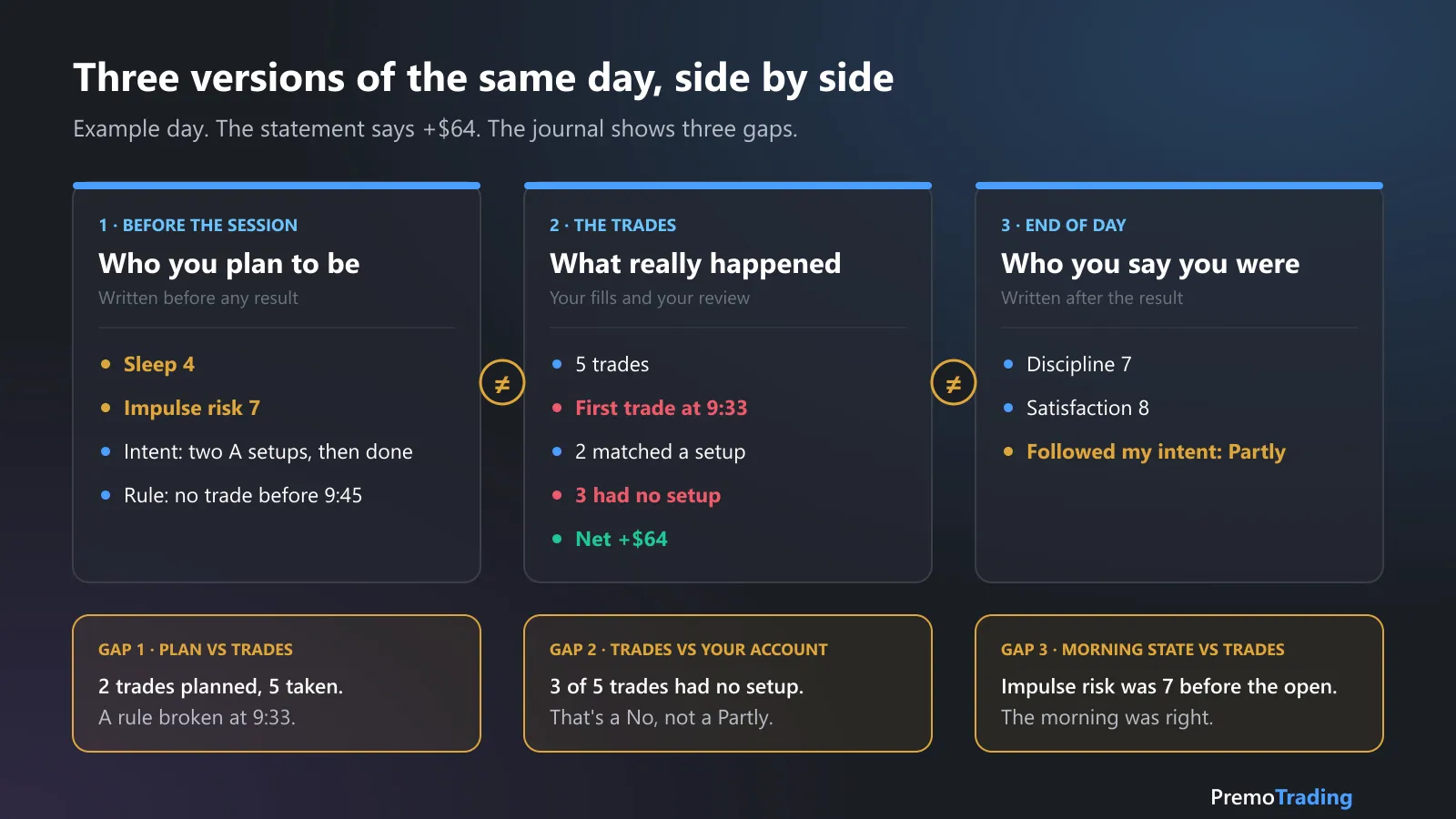
Example. A green day, and three gaps that the P&L doesn’t show.
| Before the session | The trades | End of day | |
|---|---|---|---|
| Who wrote it | You, before any result | Your fills and your review | You, after the result |
| What it says | Sleep 4, impulse risk 7. Intent: “Two A setups, then done.” Rule: “No trade before 9:45” | 5 trades, the first at 9:33. 2 matched a setup, 3 had none. Net +$64 | Discipline 7, satisfaction 8. Followed my intent: “Partly” |
Three gaps, on a day the statement calls a good one:
- Plan against trades. Two trades planned and five taken, with a rule broken three minutes into the session.
- Trades against your account. Three trades out of five with no setup is a “No”, not a “Partly”. Discipline scored 7 because the day finished green.
- Morning state against trades. Impulse risk was 7 before the open, and the morning was right. That deserves a rule of its own, such as “If impulse risk is 7 or more, then two trades at half size”.
Morning state against execution
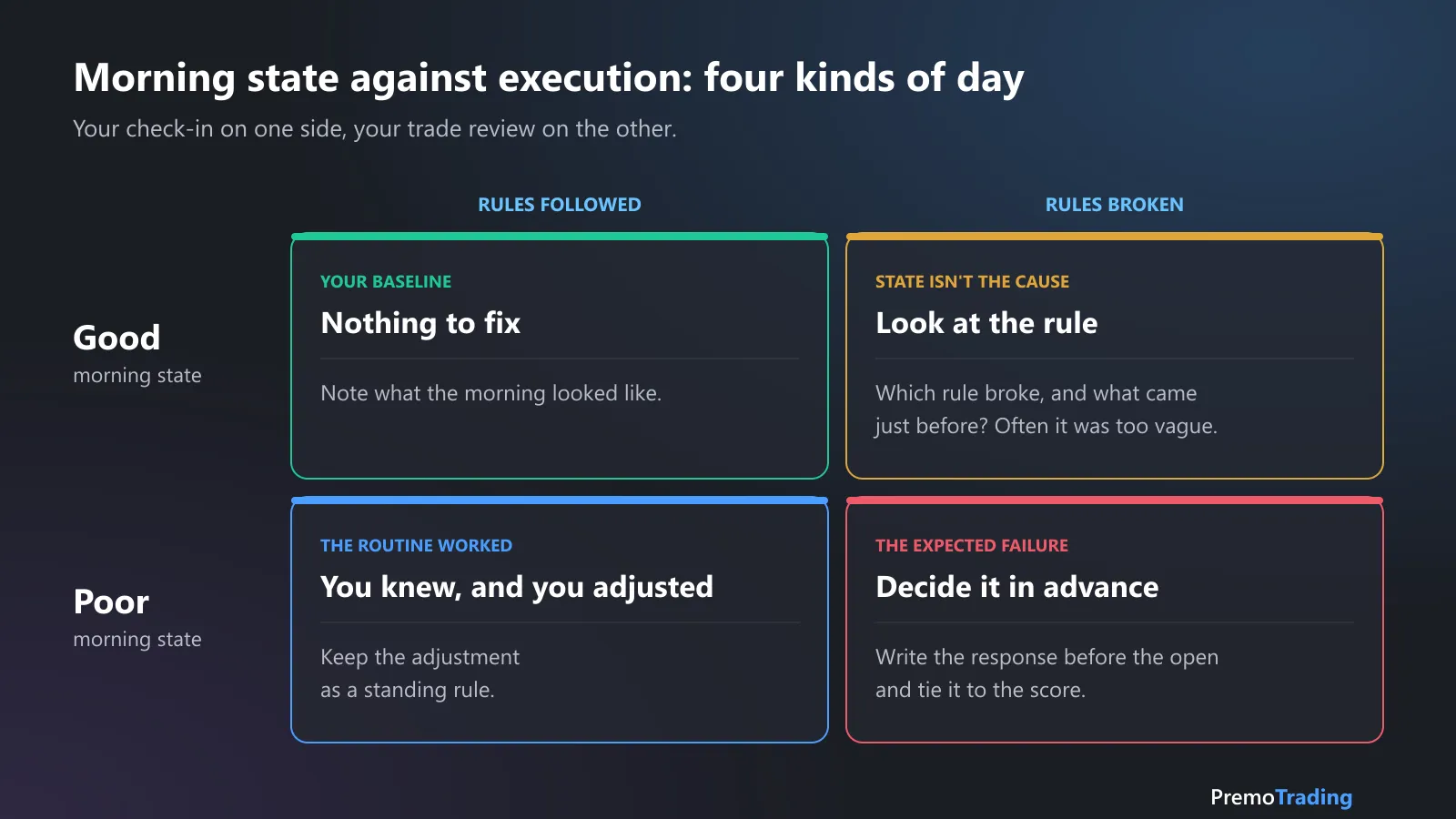
Four kinds of day, and each one asks for a different fix.
| Morning state | Execution | What it tells you | What to do |
|---|---|---|---|
| Good | Rules followed | Your baseline | Note what the morning looked like |
| Good | Rules broken | Your state isn’t the cause | Look at which rule broke and what happened just before. Often the rule was too vague to check |
| Poor | Rules followed | The routine worked: you knew, and you adjusted | Make the adjustment a standing rule |
| Poor | Rules broken | The failure you could have predicted | Decide the response in advance and tie it to the score |
Your account against the trades
| Your account says | The trades say | What it tells you |
|---|---|---|
| Followed my intent: Yes | Rules broken | A blind spot. This is the most useful gap, because you won’t fix what you score as fine |
| Followed my intent: No | Rules followed | You’re marking yourself down for a red day |
| Satisfaction tracks the P&L | Either | You’re grading the result, not how you traded |
| Yes | Rules followed | Agreement. On a red day, this is the best page in the journal |
For the biases behind these gaps, and what tilt looks like in a trade log, see our guide to trading psychology.
How many days before a pattern means anything?
More than you’d like. One day is enough to see a gap, but a pattern across days needs about 60 of them, and even then it’s a lead to test.
Keep two kinds of finding apart:
- A gap inside one day is a fact about that day. “I planned two trades and took five” needs no statistics. Write the lesson and use it tomorrow.
- A pattern across days is a claim: “I trade worse on short sleep.” Your journal adds one row a day to test it with, which is about 20 rows a month.
A few rows can show almost anything. Say your notes show a correlation of 0.50 between your sleep score and your daily P&L. This is how wide the range around that figure is:
| Days with a check-in and trades | Roughly | The real correlation could plausibly be |
|---|---|---|
| 5 | One week | −0.68 to 0.96 |
| 10 | Two weeks | −0.19 to 0.86 |
| 20 | One month | 0.07 to 0.77 |
| 60 | Three months | 0.28 to 0.67 |
An example, calculated here as a 95% interval with the Fisher z approximation. It is not data from any trader.
After two weeks, “sleep helps”, “sleep does nothing” and “sleep hurts” all fit the same notes. A simulation study of this question found that correlations in typical scenarios only become stable as the sample approaches 250 (Schönbrodt and Perugini, 2013). That’s close to a year of sessions.
So use the journal in stages:
- Days 1 to 10: use the single-day gaps and the daily lesson. Ignore every pattern.
- Days 10 to 60: write patterns down as questions. “Do I break rules more when impulse risk is 7 or above?”
- After about 60 days: turn one question into a rule, then see whether the next 60 days agree.
Remember that a score rarely moves alone. A short night might also be a day you started late and missed your best hour. The journal tells you where to look. It doesn’t tell you the cause.
A trading psychology journal template you can copy
One page per trading day. Fill in part 1 before the first trade and never afterwards.
TRADING DAY: ____________

1. BEFORE THE SESSION - who I plan to be    (2 minutes, before the first trade)
Scores 0-10:   Energy __   Focus __   Stress __
               Confidence __   Impulse risk __   Sleep __
Intent:        ______________________________   (a stranger could check it)
Rules today:   1. ___________________   2. ___________________
Red flags:     ______________________________   (what tells me to stop)

2. THE TRADES - what really happened        (1 minute a trade)
#   Setup          Confluences   Followed it?   Planned R   Realized R   Grade
1   ____________   __ of __      Yes / No       ____        ____         __
2   ____________   __ of __      Yes / No       ____        ____         __
3   ____________   __ of __      Yes / No       ____        ____         __

3. END OF DAY - who I say I was             (3 minutes, whatever the P&L)
Scores 0-10:   Discipline __   Patience __   Focus __
               Emotional control __   Stress __
               Satisfaction with how I traded __
Did I follow my intent?     Yes / Partly / No
What I did right:           ______________________________
What I'd do differently:    ______________________________
State of mind:              ______________________________
One lesson for tomorrow:    If ________________, then I will ________________.

SIDE BY SIDE
Plan against trades:            ______________________________
Trades against my account:      ______________________________
Morning state against trades:   ______________________________
Copy it into a notebook or a document. The last three lines are the ones that change your trading, so don’t skip them on a good day.
How Premo helps
Premo Trading keeps all three versions of the day in one journal and puts them next to each other:
- A start of day check-in in Trader Psychology. Six sliders for energy, focus, stress, confidence, impulse risk and sleep, plus your intent for the session, the rules you mean to follow and the red flags you’re watching for. Saving it works out a Mindset score, and stress and impulse risk count against it.
- A review of each trade against its setup in the Playbook. You tick the confluences that were really there and any warning signs, compare planned R with realized R and grade your execution. Each reviewed trade gets a Gate Pass and a Confidence score out of 100.
- An end of day review. Six scores: discipline, patience, focus, emotional control, stress, and satisfaction with how you traded whatever the P&L. Together they make a day score, and stress counts against it. “Did I follow my intent?” is answered Yes, Partly or No, with the intent and rules you wrote that morning shown beside it. Then four notes in your own words: what you did right, what you’d do differently, your state of mind and one lesson for tomorrow.
- One check-in and one review per trading day. The trading day is the US Eastern day.
- A Psychology correlation card on Trader Summary. It sets your start of day check-ins against your P&L and win rate, and compares your low days with your high days. It reads the check-ins only, not the end of day review, and the app tells you to treat it as a hint until there are enough check-ins.
With AI Insights switched on, saving the check-in brings a short note from the Mindset coach: what went well, one thing to watch, and a focus for today tied to your own rules, with a pace of normal, steady or ease in. It reads today’s check-in, your recent check-ins, the previous trading day’s results and your last end of day review, so the lesson you wrote carries into the next morning’s focus. AI Insights is opt-in on paid plans, and your check-in and review scores and notes are sent to OpenAI only after you opt in. The coach never says what to trade, and it is not financial advice.
Journal the trader and the trade in Premo14 days free, then $19.99/month plus tax. Cancel before your trial ends and you won't be charged. New customers only.
Start your 14-day free trialSources
- Baron, J. and Hershey, J. C. (1988), Outcome bias in decision evaluation, Journal of Personality and Social Psychology, 54(4), 569-579.
- Gollwitzer, P. M. (1999), Implementation intentions: strong effects of simple plans, American Psychologist, 54(7), 493-503.
- Harrison, Y. and Horne, J. A. (2000), The impact of sleep deprivation on decision making: a review, Journal of Experimental Psychology: Applied, 6(3), 236-249.
- Schönbrodt, F. D. and Perugini, M. (2013), At what sample size do correlations stabilize?, Journal of Research in Personality, 47(5), 609-612.
- CME Group: Micro E-mini Nasdaq-100 contract specs: MNQ is $2 per index point.
This article is educational and is not investment advice. The trades, scores and figures shown are examples, not recommendations or results. Trading involves substantial risk of loss.
Frequently asked questions
What is a trading psychology journal?
A trading psychology journal is a daily record of the trader, kept next to the record of the trades. It has three entries a day: a check-in on your state and intent before the session, a review of each trade against its written setup, and an end-of-day review of how you traded, whatever the P&L.
How is a trading psychology journal different from a trade journal?
A trade journal has one row per trade: symbol, size, prices, P&L and your notes on the setup. A trading psychology journal has one page per day about the person: your state before the session, what you intended, and how you say you traded. You need both, because the gaps between them are what you review.
When should I fill in the pre-session check-in?
Before your first trade, and ideally before you look at a chart. A score written after the session is shaped by the result, so it describes the day you had and not the state you started in. If you miss a morning, leave it blank. Don't fill it in from memory.
How long does a trading psychology journal take each day?
About two minutes before the session for the scores, the intent and the rules, about a minute a trade for the review, and about three minutes at the end of the day. The scores take seconds. Most of the time goes on one honest answer and one lesson for tomorrow.
How many days until the patterns in a psychology journal mean something?
One day is enough to see a gap between what you planned and what you did, and to write a lesson. A pattern across days needs far more: with ten days, a correlation of 0.50 could plausibly be anywhere from −0.19 to 0.86. Treat anything under about 60 days as a hint.
Can I keep a trading psychology journal on paper?
Yes. The routine is three short entries a day and needs nothing but a page per day and the template in this guide. Software helps later, when you want to count 60 days of scores against your results, because that part is slow and error-prone by hand.