
What to write in a trading journal (with an example entry)
What to write in a trading journal: seven fields to fill in for every trade, what to leave out, when to write, and a worked MNQ example entry.
In a trading journal, write the seven things your broker can’t record: the setup, its grade, your planned stop and target, whether you followed the plan, why you exited, your state of mind and one lesson. Prices, times, fees and P&L come from your broker’s export. A useful entry takes about 60 seconds a trade.
Most journals fail in one of two ways. Some are a copy of the broker statement: every price, no reasons. Others are a diary: long paragraphs that nobody reads again. A journal that works sits between the two. It is short, it is written close to the decision, and every field can be counted at the end of the week.
This guide covers the seven fields, what to leave out, when to write, a worked example on Micro E-mini Nasdaq-100 futures (MNQ), and what the notes tell you after a month.
Key takeaways
- Write the reasons, import the numbers. Your broker’s export already has prices, times, fees and P&L.
- Seven fields, 60 seconds. Setup, grade, plan, plan followed, exit reason, state of mind, one lesson.
- Pick from a list where you can. A choice can be counted. A paragraph can’t.
- Write the lesson as a rule: “If X happens, then I will do Y.”
- The exit reason pays for the whole journal. It shows where you give money back.
What should you write in a trading journal?
Write the seven things that explain a trade. Each one answers a question you’ll ask when you review.
| # | Field | How to write it | The question it answers |
|---|---|---|---|
| 1 | Setup | The name from your playbook | Which setups make money? |
| 2 | Grade | S to D, decided before the entry | Do my best-looking trades pay the most? |
| 3 | Plan | Stop, target and planned R | Did I take the trade I planned? |
| 4 | Followed the plan | Yes or no, plus the rule you broke | What does breaking my rules cost? |
| 5 | Exit reason | One choice from a short list | Where do I give money back? |
| 6 | State of mind | One word | Which states come before my worst trades? |
| 7 | One lesson | One sentence, as a rule for next time | What will I do differently? |
1 and 2. Setup and grade
Write the setup’s name exactly as it appears in your playbook: “VWAP pullback” every time, never “pullback long” one day and “VWAP bounce” the next. If the spelling changes, the trades can’t be grouped.
Grade the trade by counting how many of the setup’s confluences were present, and decide the grade before the entry, even if you type it afterwards. A grade given after the result is just the result in disguise. If you can’t remember what you decided, write “not graded” - don’t invent it.
When a setup is written down with its confluences, you don’t need a paragraph on why you entered. The setup name and the confluences you ticked are the entry reason. Our guide to trading setups shows how to write and grade them.
3. The plan: stop, target and planned R
Record the stop and target you set before the entry, and the risk-reward ratio they give you. Planned R is the benchmark. Without it, you can only compare a trade with zero. With it, you can compare the trade with what you intended.
4. Followed the plan: yes or no
No half marks. If the answer is no, name the rule: entered before the trigger, moved the stop, traded bigger than planned, took profit before the target, traded after the daily limit. This is the most honest field in the journal, and the one most often left blank. If you don’t have written rules to check against yet, start with a trading plan.
5. Exit reason
Pick one from a fixed list and keep the list short:
- Target hit
- Planned stop
- Trailing stop
- Closed early
- Moved or widened the stop
- Time or end of session
Six choices are enough. The value comes from adding them up, as the example further down shows.
6. State of mind
One word for how you felt at the entry: calm, rushed, anxious, bored, frustrated, overconfident. A paragraph about your feelings is hard to review. One word across 40 trades is a table. More on this in trading psychology.
7. One lesson
Write it as a rule for next time, in the form “If X happens, then I will do Y”. Research on these if-then plans, called implementation intentions, found they are acted on more reliably than general goals (Gollwitzer, 1999).
- Not a lesson: “Be more patient.”
- A lesson: “If price stalls after 1R, then I move the stop to breakeven and wait.”
Not every trade has one. “None - traded the plan” is a valid entry, and the best one you can write.
What should you leave out of a trading journal?
Leave out anything your broker already recorded, and anything you’ll never count.
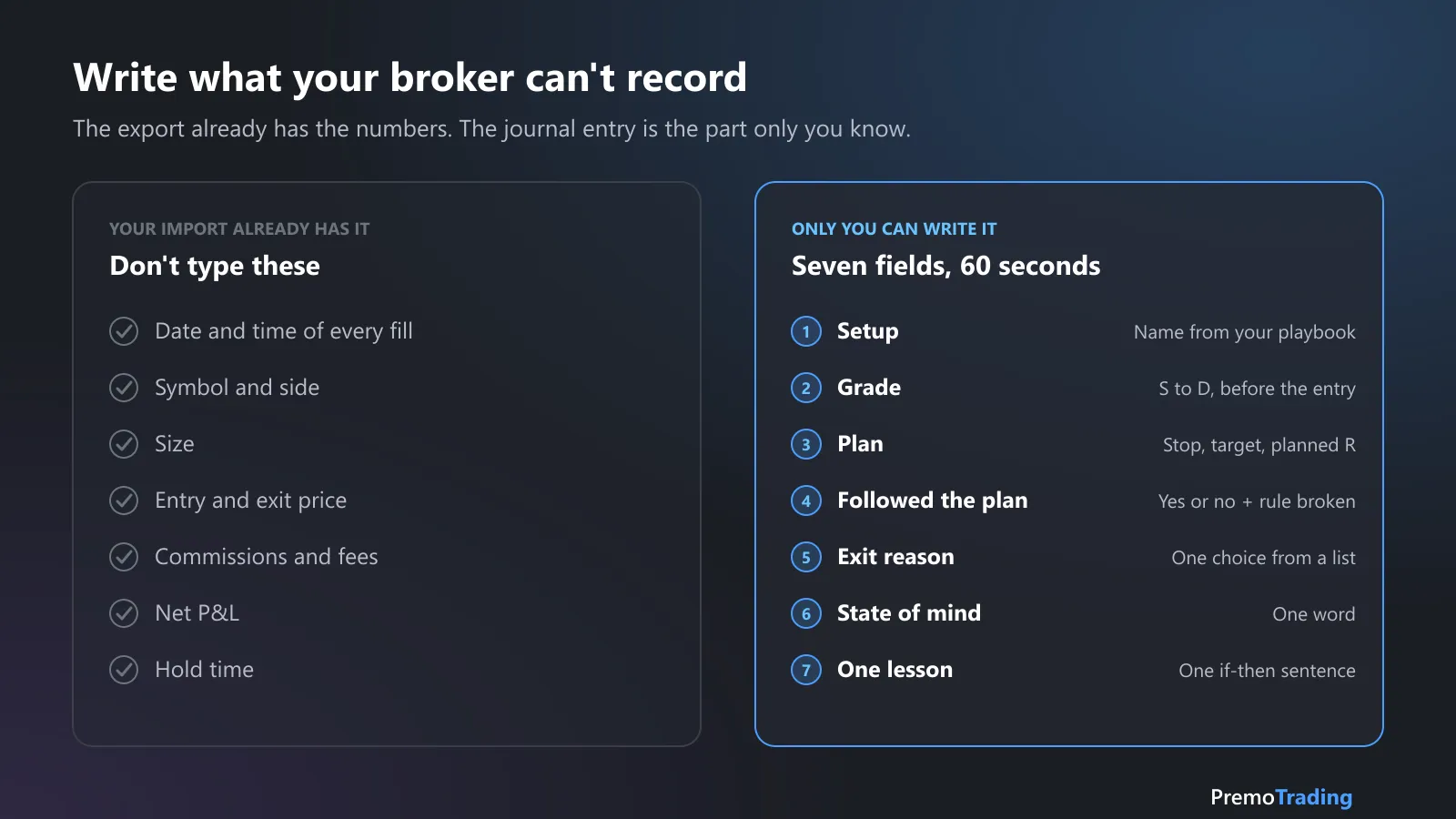
Typing prices by hand uses up the minute you have for the part that matters.
- Prices, times, size, fees and P&L. They’re in the export, and the export doesn’t make typing mistakes.
- Market commentary. “NQ was weak because yields rose” is a story. Unless it’s a condition of your setup, it won’t help you review.
- Hindsight. “Should have held” isn’t a lesson. It’s the result, restated.
- Long narratives. If a field regularly takes more than a sentence, turn it into a list of choices.
- How the dollar amount felt. Record the state you were in at the entry, when you made the decision. How the result felt afterwards is a different thing.
When should you write in your trading journal?
Write as close to the decision as you can. Memory rewrites reasons once the result is known: by the close you remember the P&L clearly and the reason vaguely.
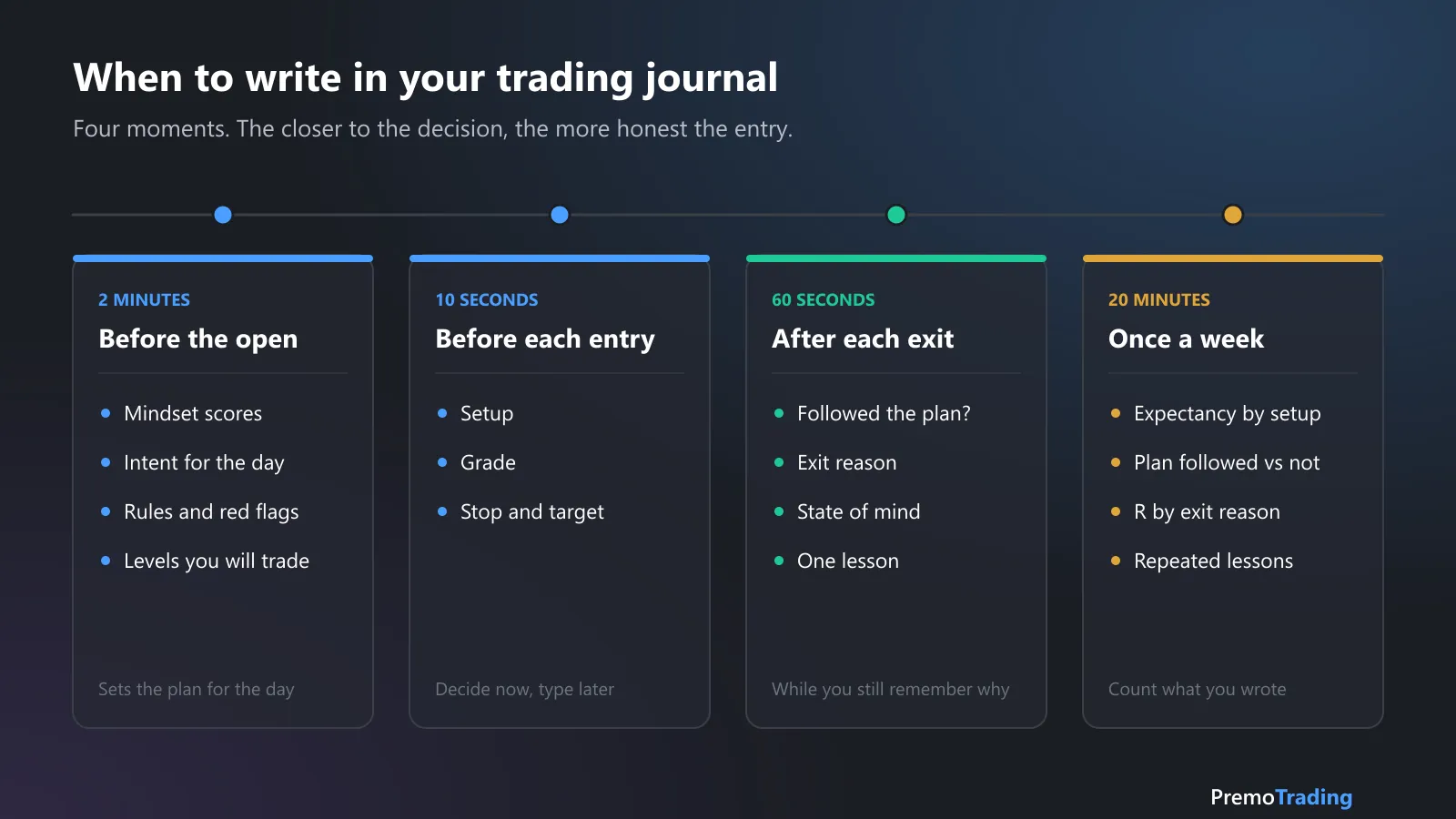
Four moments. Only the third one happens after you know the result.
| When | Time | What you write |
|---|---|---|
| Before the open | 2 minutes | How you feel, your intent for the day, your rules, your red flags, the levels you’ll trade |
| Before each entry | 10 seconds | Setup, grade, stop and target. Decide now, type later if you must |
| After each exit | 60 seconds | Followed the plan, exit reason, state of mind, one lesson |
| Once a week | 20 minutes | Nothing new. Count what you wrote |
If the market is too fast to write between trades, say the grade out loud before the entry and fill in the entry at the next pause. What matters is that the grade and the plan were set before the result.
What does a good trading journal entry look like?
It’s short, and a stranger could count it. Compare two entries for the same trade:
| Weak entry | Useful entry | |
|---|---|---|
| Setup | “Long, looked strong” | VWAP pullback |
| Grade | - | A, 4 of 5 confluences |
| Plan | - | Stop 20,024, target 20,060, 2R |
| Followed the plan | “Mostly” | No: closed before the target |
| Exit reason | “Got nervous” | Closed early |
| State of mind | “OK I guess” | Anxious |
| Lesson | “Need more discipline” | If price stalls after 1R, I move the stop to breakeven and wait |
Here’s the useful entry in full. The trade is the VWAP pullback from our guide to what a trading strategy is: long 2 MNQ at 20,036, stop at 20,024, target at 20,060.
MNQ long, 2 contracts, 9:52 a.m. ET            (imported: prices, fees, P&L)

Setup:            VWAP pullback
Grade:            A - 4 of 5 confluences (pullback volume was not lighter)
Plan:             Stop 20,024 | Target 20,060 | Planned 2R
Followed plan:    No - closed at 20,051, before the target
Exit reason:      Closed early
State of mind:    Anxious (first trade after a loss)
Lesson:           If price stalls after 1R, I move the stop to
                  breakeven and wait. The stop or the target decides.
MNQ is worth $2 a point, so the numbers behind the entry are:
| Points | Dollars (2 MNQ) | R | |
|---|---|---|---|
| Planned risk | 12 | $48 | 1R |
| Planned target | 24 | $96 | 2R |
| Actual result | +15 | +$60 | +1.25R |
| Left on the plan | 9 | $36 | 0.75R |
The P&L says “+$60, a good trade”. The journal says “kept 63% of the planned profit and broke an exit rule”. Only the second one tells you what to work on. The trade made money, and it still goes in the “no” column.
What do your notes tell you after a month?
They tell you where your money goes. Here’s an example month of 40 MNQ trades, one contract each, with a 20-point stop, so 1R is $40 before commissions.
| Exit reason | Trades | Average R | Total R | Dollars |
|---|---|---|---|---|
| Target hit | 11 | +2.00R | +22.00R | +$880.00 |
| Planned stop | 17 | −1.00R | −17.00R | −$680.00 |
| Closed early | 8 | +0.40R | +3.20R | +$128.00 |
| Moved or widened the stop | 4 | −1.44R | −5.76R | −$230.40 |
| All trades | 40 | +0.06R | +2.44R | +$97.60 |
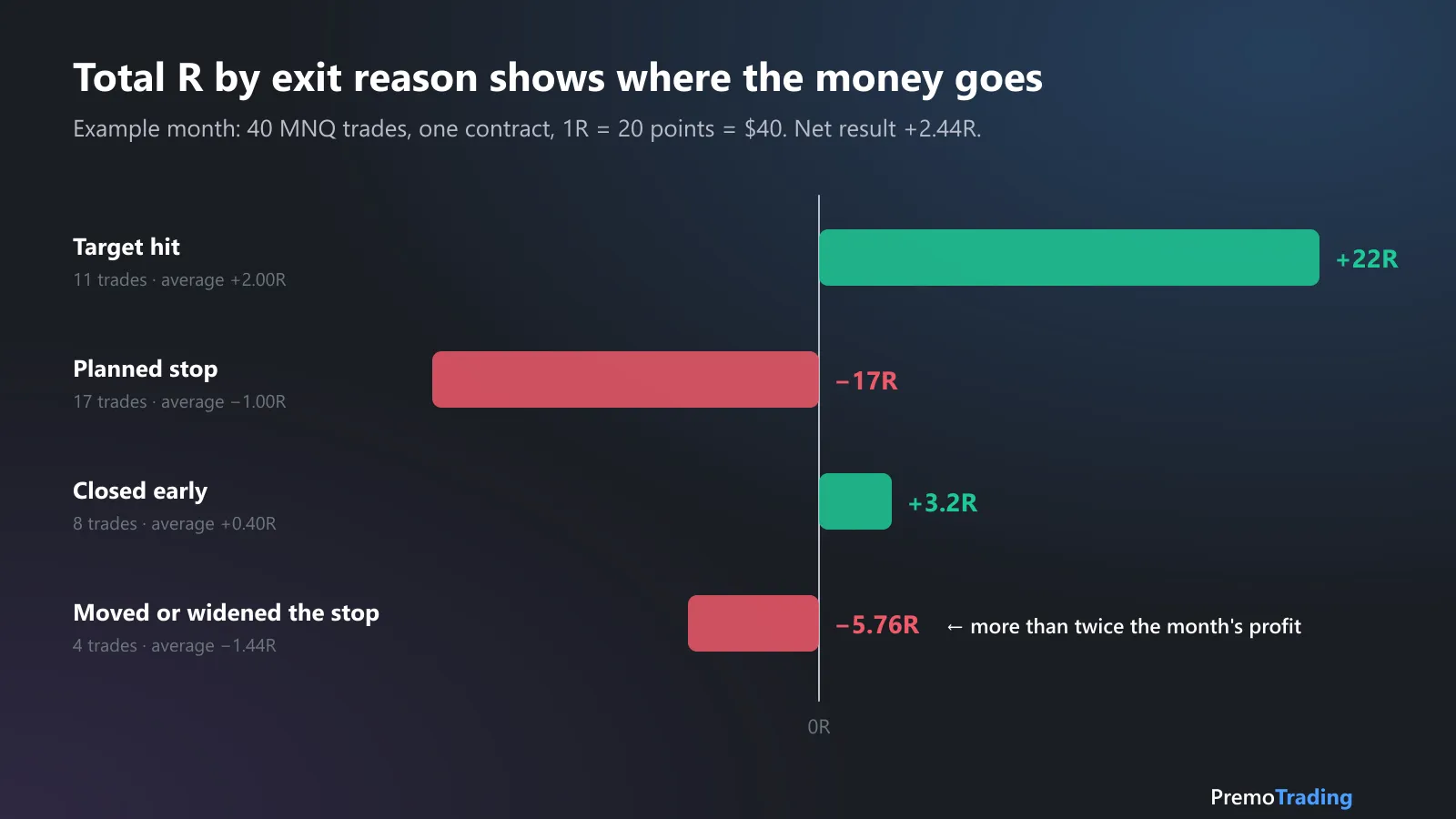
Example. Four trades with a moved stop cost more than twice what the whole month made.
The statement shows a month that barely broke even: +$97.60. The exit reasons show why.
- The plan works. The 28 trades that ended at the target or the planned stop made +5R between them.
- Four trades did the damage. Moving the stop cost 5.76R. Without those four trades, the month is +8.2R, or $328.
- Early exits need a second look. Eight winners averaged +0.40R on a 2R plan. Go back to the chart for each. If five went on to the target and three went on to the stop, closing early cost you 8R on the five and saved you 4.2R on the three: a net cost of 3.8R, more than the month’s profit.
None of that is visible in a P&L column. All of it comes from one field that takes five seconds to fill in. Once you know your numbers, the expectancy calculator shows what fixing one leak does to your average trade, and our guide to expectancy explains how to read it.
Should you grade the decision or the result?
Grade the decision. People judge the same decision as better when it turns out well, even when they know the outcome was down to chance. Psychologists call this outcome bias (Baron and Hershey, 1988). In trading it means a winner that broke your rules feels like skill, and a loss taken at your planned stop feels like a mistake.
The journal is where you correct for that:
- A loss at your planned stop, on a setup you graded A, is a good trade.
- A win after you moved your stop is a bad trade that happened to pay.
That’s why “followed the plan” is a separate field from P&L. Review them together and you’ll see four kinds of trade: followed and won, followed and lost, broke the rules and won, broke the rules and lost. The third is the dangerous one, because it teaches a habit that shows up in our list of common trading mistakes.
Should you take a screenshot of every trade?
Yes: one chart, taken at the exit, on the timeframe you trade from, with the entry, stop and target marked. Add a higher-timeframe chart only when context was part of the setup.
Screenshots can’t be counted, so they support the seven fields. They don’t replace them. Their job comes at the weekly review, when you put your three best and three worst trades side by side and ask what the best ones had in common.
What should you review each week?
Nothing new gets written. You count what’s already there:
- Expectancy by setup. Which setups to keep, and which to rewrite or retire.
- Results by grade. Whether your A trades really beat your B trades.
- Plan followed, yes against no. What your rule breaks cost in R.
- Total R by exit reason. Where the money goes back.
- State of mind before your three worst trades. Whether the same word keeps appearing.
- Lessons. Any lesson you wrote twice becomes a rule in your trading plan.
One change a week is enough. A journal isn’t measured by how much you write in it. It’s measured by whether next month’s trades look different.
How Premo helps
Premo Trading splits the work the way this guide does. The numbers come from your import, and you add the reasons:
- Import your fills and the trade journal rebuilds them into positions, with weighted-average entry and exit, commissions and fees. No prices to type.
- Review each trade against its setup in the Playbook. Pick the setup, tick the confluences that were really there and any warning signs, and the stop and target fill in from the setup’s rules.
- See the R you planned next to the R you made, grade your execution from S to D, and add your notes - the place for the exit reason and the lesson.
- Get a Confidence score out of 100 for how well the trade matched its setup. A loss taken at your stop on a well-followed setup scores as well as a win at the target.
- Check in before the open with six mindset scores, your intent, your rules and your red flags, then see how each score lines up with your results.
Sources
- Baron, J. and Hershey, J. C. (1988), Outcome bias in decision evaluation, Journal of Personality and Social Psychology, 54(4), 569-579.
- Gollwitzer, P. M. (1999), Implementation intentions: strong effects of simple plans, American Psychologist, 54(7), 493-503.
- CME Group: Micro E-mini Nasdaq-100 contract specs: MNQ is $2 per index point.
This article is educational and is not investment advice. The trades, statistics and results shown are examples, not recommendations or actual results. Trading futures involves substantial risk of loss.
Frequently asked questions
What should I write in my trading journal after each trade?
Seven things your broker can't record: the setup, its grade, your planned stop and target, whether you followed the plan, why you exited, your state of mind at the entry, and one lesson written as a rule for next time. Prices, times, fees and P&L should come from your broker's export, not from typing.
What does a good trading journal entry look like?
It is short and countable. For example: Setup - VWAP pullback. Grade - A, 4 of 5 confluences. Plan - stop 20,024, target 20,060, 2R. Followed the plan - no, closed before the target. Exit reason - closed early. State of mind - anxious. Lesson - if price stalls after 1R, I move the stop to breakeven and wait.
How long should a trading journal entry take?
About 60 seconds a trade. If it takes longer, you are writing things that can't be counted later. Use fixed choices for the setup, grade, exit reason and state of mind, and keep free text to one sentence for the lesson.
Should I journal every trade, including small ones and scratches?
Yes. Skipped entries are rarely random: traders tend to skip the trades they would rather forget, and those are the ones with the most to teach. A journal with only the good trades gives you statistics that flatter you.
Should I write about my emotions in a trading journal?
Yes, but as one word at the entry - calm, rushed, anxious, bored, frustrated or overconfident - not as a paragraph. One word can be counted, so after a few weeks you can see which states come before your worst trades.
What is the most important thing to record in a trading journal?
Whether you followed your plan, and why you exited. Those two fields separate losses that came from the market from losses that came from you, and only the second kind can be fixed by changing your behaviour.
Do I need to write down prices and P&L by hand?
No. Entry and exit prices, times, size, fees and P&L are already in your broker's export, and a journal that imports it will be more accurate than typing. Spend your writing time on the reasons, which no export contains.